




The Island That Defined Fresh
There is a moment that every visitor to Kalymnos eventually experiences. You are sitting at a table overlooking the Aegean, a plate arrives, and the first bite stops you completely. Not because of complexity or technique — but because of an almost shocking clarity of flavor. That is what genuine freshness tastes like, and in Kalymnos, it is not an accident. It is the output of a centuries-old system that runs from pre-dawn departures at the port to a plate in front of you by noon.
Kalymnos sits in the southeastern Aegean, part of the Dodecanese island chain, and it has never fully transitioned from working island to resort island. The fishing fleet is real. The fishermen are not performing tradition for cameras — they are doing what their fathers and grandfathers did, because the sea here is productive, the knowledge is inherited, and the demand from local tables is constant. Understanding how that system works — from the method of catch to the method of preparation — is the key to understanding why the seafood in Kalymnos occupies a category of its own.
Before Dawn: The Logic of the Kalymnian Fishing Day
The Kalymnian fishing day begins in darkness. By 3 or 4 in the morning, small wooden boats called trehandiri are already moving out of Pothia harbor, navigating by memory and instinct toward spots that families have fished for generations. The locations are not marked on public maps. They are passed down verbally, held close, treated as inheritance.
Different seasons dictate different methods. Trammel nets are set in the evening and retrieved at dawn, trapping fish by the gills as they move through the water column overnight. Long-line fishing targets deeper species — including swordfish — using baited hooks deployed at significant depth. Octopus is often caught by a combination of trap pots and direct harvesting by divers, a skill the island developed through its sponge-diving heritage.
What distinguishes Kalymnos from more industrialized fishing cultures is scale and selectivity. These are small-boat operations catching manageable quantities of high-quality fish. There is no factory trawler logic here. The fisherman knows his yield, knows his buyers, and returns to port with a catch that will be sold and consumed the same day.
Octopus: The Icon of Kalymnian Seafood Culture
No ingredient in Kalymnos carries more cultural weight than the octopus. Visitors often photograph the lines of octopus hanging to dry in the sun — a scene so visually striking it has become the postcard image of the island. But this is not aesthetic. It is process.
Freshly caught octopus is tough. The traditional Kalymnian method begins immediately after landing: the fisherman beats the octopus repeatedly against flat rocks at the water’s edge — sometimes forty or fifty times — to break down the muscle fiber. This is not improvisation. It is precision technique developed over generations to achieve a specific texture.
After beating, the octopus is hung in direct sunlight and left to dry for several hours, sometimes a full day. The sun draws out moisture, concentrates the flavor, and continues the tenderizing process. What emerges is an ingredient fundamentally different from boiled or commercially processed octopus sold elsewhere.
The final step is the grill. Over charcoal, the dried octopus caramelizes on the exterior while remaining yielding inside. The flavor is deep, smoky, mineral, and slightly sweet — a direct expression of the Aegean seabed where it lived. Paired with a splash of red wine vinegar and a pour of local olive oil, it is one of the most complete bites in Greek cuisine.
Swordfish: The Deep-Water Prize
Swordfish (ξιφίας) is caught in the deeper channels of the Aegean surrounding Kalymnos using long-line methods, typically at night when the fish rise from depth toward the surface. It is seasonal — peak availability runs from late spring through summer — and the quality of locally caught swordfish differs noticeably from the frozen product that reaches most of mainland Greece.
The flesh of fresh Aegean swordfish is firm, pale, and finely grained, with a fat content that makes it ideal for direct grilling over high heat. In Kalymnos, it is almost always prepared simply: thick steaks brushed with olive oil, grilled on both sides, finished with lemon and dried oregano. No sauces, no reductions, no embellishment. The philosophy is consistent across the island’s seafood culture — great ingredients require restraint, not elaboration.
What makes the local swordfish exceptional is the combination of cold, deep water and minimal transit time. A fish caught at 2 in the morning and grilled at 1 in the afternoon has a flavor and texture that no supply chain can replicate.
Sea Urchin: The Purist’s Test
If octopus is Kalymnos’s icon, sea urchin (αχινός) is its purity test. Harvested by hand from rocky underwater formations at depths accessible to local divers, sea urchin in Kalymnos is served in the most uncompromising way possible: split open at the table, eaten raw with a small spoon, accompanied by nothing but lemon juice.
The roe — the edible orange or yellow tongues inside the shell — should be briny without being aggressive, creamy without being heavy, and carry a clean oceanic finish. Bad sea urchin tastes of ammonia and decay. Good sea urchin, harvested and served the same morning, tastes like the sea has been distilled into something you can hold on your tongue.
Kalymnian sea urchin consistently falls in the latter category because the supply chain is essentially nonexistent. There is no refrigeration, no transit, no delay. The urchin was underwater hours ago. That proximity is everything.
Nautika Valsamidis: Where the System Becomes a Meal
Understanding the fishing culture of Kalymnos is one thing. Experiencing it properly requires a table at the right place, and Nautika Valsamidis is precisely that.
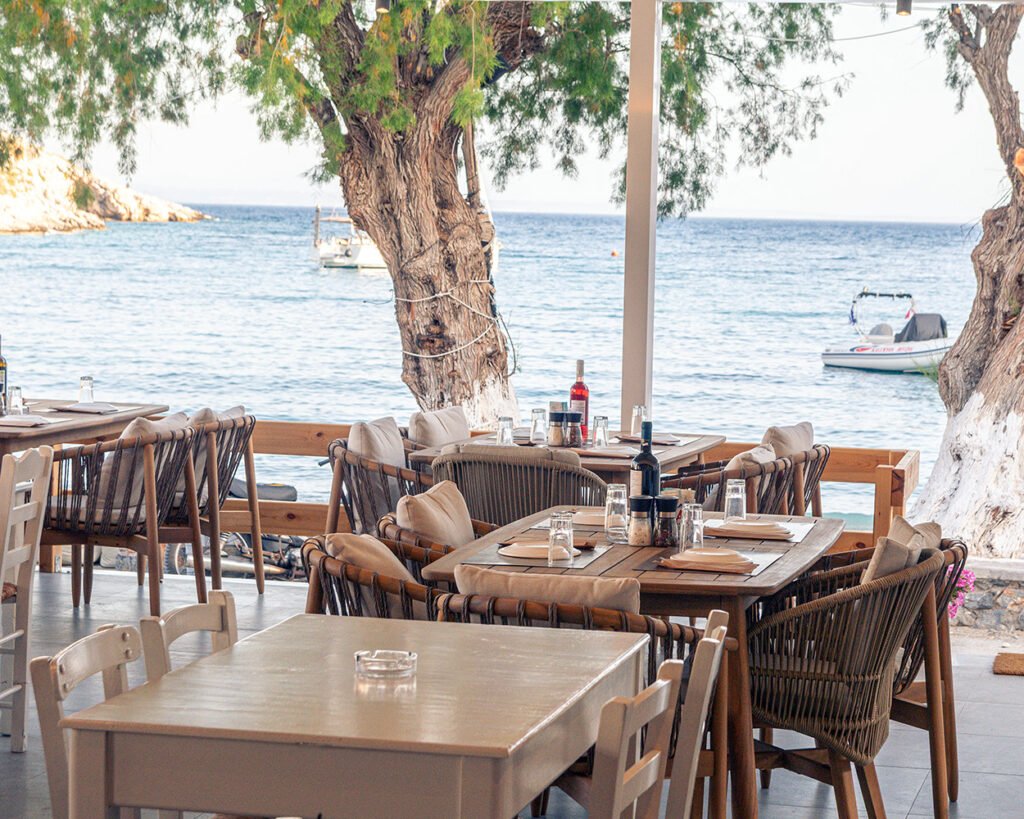
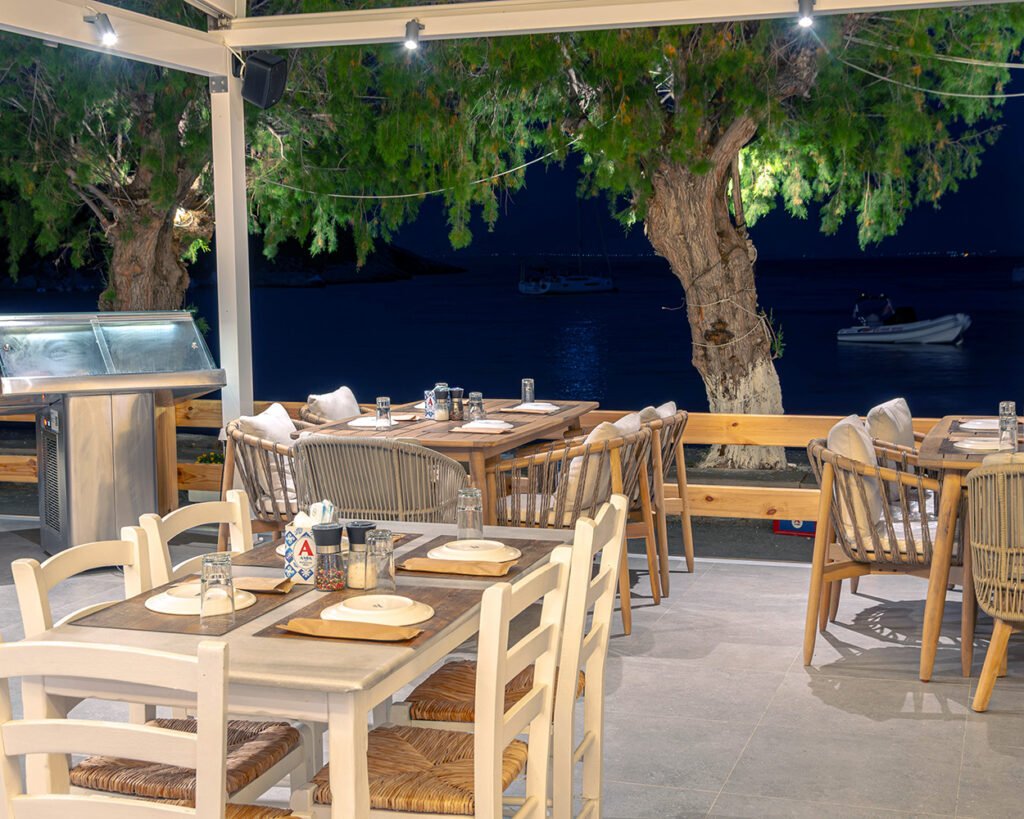
Positioned directly at the water’s edge, Nautika Valsamidis has established itself as the restaurant where the island’s sea-to-table philosophy is executed with full commitment. The kitchen works with what the boats bring in — the menu is not fixed, it is responsive. On a given day, you might find that morning’s swordfish on the grill, octopus that was hanging by the port at sunrise, and sea urchin cracked open just before service.
What separates Nautika Valsamidis from establishments that merely claim freshness is operational integrity. The relationships between the restaurant and the fishing community are direct and longstanding. This is not a marketing narrative — it is a logistics reality. Ingredients arrive fast, are handled carefully, and are prepared by people who understand that their job is to get out of the way of exceptional raw material.
The atmosphere reinforces the experience. There is nothing pretentious about Nautika Valsamidis. It is a serious seafood restaurant on an island that takes seafood seriously, and the two are exactly matched.
For travelers coming to Kalymnos specifically to eat well — and there are many who do — a meal at Nautika Valsamidis functions as both introduction and conclusion. It is where the island’s identity lands on a plate.
The Preparation Philosophy: Why Simplicity Is the Point
A recurring observation among chefs who visit the Aegean is that the best seafood restaurants in Greece barely cook the fish at all. This sounds like a paradox. It is actually a description of confidence.
When your octopus was caught this morning, when your swordfish has never seen a freezer, when your sea urchin was in the water three hours ago — adding complexity would be an act of insecurity. The Kalymnian kitchen understands this instinctively. A splash of lemon, a pour of olive oil, a pinch of sea salt, an open flame. That is the technique. The ingredient is the cuisine.
This approach also explains why attempts to replicate Kalymnian seafood elsewhere so frequently disappoint. The preparation method can be copied. The raw material cannot.
FAQ
What time of year is best for sea urchin in Kalymnos? Sea urchin season typically runs from late autumn through early spring, roughly October to April, when roe is at peak fullness. Summer visitors will find availability limited or absent. If sea urchin is a priority, plan accordingly.
How is Kalymnos swordfish different from what you find in supermarkets? The primary difference is freshness and handling. Commercially available swordfish is almost always previously frozen, which breaks down the cellular structure of the flesh and causes moisture loss during cooking. Fresh-caught swordfish, cooked the same day, retains its natural fat distribution and has a cleaner, more complex flavor.
Is the octopus-beating ritual still practiced today? Yes. While some establishments use mechanical tenderizing methods, traditional fishermen and family-run tavernas in Kalymnos still beat octopus against rocks as a matter of pride and habit. The method produces genuinely superior results.
Can visitors watch the fishing boats return to Pothia port? Yes. The main port of Pothia sees morning activity between roughly 6 and 10am depending on the season and weather. It is an authentic scene with no tourist staging — fishermen unloading, sorting, and selling directly from the boats.
Does Nautika Valsamidis require a reservation? During peak season (July–August), booking ahead is strongly recommended. In shoulder months, walk-ins are generally accommodated, but calling ahead remains advisable given the restaurant’s reputation among both locals and informed travelers.
Why does Kalymnos seafood taste different from the same species served in Athens? Two primary reasons: transit time and water temperature. Fish caught and served locally in Kalymnos may be hours old. The same species reaching Athens has passed through wholesalers, transport, and storage — often 24 to 72 hours from catch to plate. Additionally, the cold, deep Aegean waters around Kalymnos produce fish with firmer muscle tone and more developed flavor than those from warmer, shallower areas.
Is it appropriate to ask restaurant staff what came in that day? Not only appropriate — it is expected and welcomed. In Kalymnos, a restaurant that cannot answer this question specifically is one worth reconsidering. Good establishments are proud of what arrived that morning and will tell you in detail.
In Kalymnos, the sea is not a backdrop. It is the kitchen. Everything else is logistics.